
Last updated June 24, 2026
The Complete Guide to Garage Door in Jacksonville
Most garage door guides were written for somewhere else. They assume mild winters, low humidity, and a climate where steel doesn’t rust and wood doesn’t swell. Jacksonville is none of those things. With 54 inches of annual rainfall, summer humidity that regularly exceeds 90%, salt air pushing inland from the Atlantic and St. Johns River, and a hurricane season that runs half the year, Jacksonville puts mechanical systems through conditions that would baffle a contractor in Cincinnati or Denver. This guide covers everything — materials, components, wind-load codes, corrosion zones, and maintenance — through a Northeast Florida lens, because that’s the only lens that actually matters here.
Quick Answer
A garage door in Jacksonville, FL is a climate-stressed mechanical system that requires hurricane-rated wind-load compliance, corrosion-resistant hardware, and regular humidity-accelerated maintenance that generic national guides never address. The right door for Jacksonville depends on your distance from the coast, your HOA requirements, and whether your current system can survive a 120 mph wind event without voiding your homeowner’s insurance. If your door is more than 10–12 years old or shows rust, warping, or spring fatigue, it’s worth having a professional evaluate it before hurricane season opens in June.
Table of Contents
- How Jacksonville’s Climate Attacks Your Garage Door
- Wind-Load Ratings, Hurricane Codes, and Insurance in Jacksonville
- Salt-Air Corrosion Zones: Atlantic Beach, Ponte Vedra, Mayport, and Beyond
- Which Door Materials Actually Hold Up in Northeast Florida
- Understanding Your Full Garage Door System — and How Each Part Fails Here
- Garage Door Openers in Jacksonville’s Heat and Humidity
- A Seasonal Maintenance Schedule Built for Jacksonville
- Common Mistakes to Avoid
- When to Call a Professional
- Frequently Asked Questions
- The Bottom Line
How Jacksonville’s Climate Attacks Your Garage Door
Jacksonville’s weather doesn’t just age garage doors — it accelerates every failure mode simultaneously. High heat expands metal tracks and door panels during the day; overnight cooling contracts them. Do that 300 days a year and you get fasteners that work themselves loose, tracks that drift out of alignment, and weatherseals that crack and harden in under three years instead of the seven or eight you’d expect in a drier climate.
Humidity is the bigger villain. When ambient humidity sits above 85% for weeks at a stretch — which is standard in Jacksonville from May through September — the moisture works into every uncoated metal surface. Torsion springs are the first casualty. In dry climates, a standard spring set might last 8–10 years or 10,000 cycles. In Northeast Florida’s humidity, we regularly see spring fatigue and surface rust by year five or six on doors that haven’t been lubricated seasonally.
Steel cables corrode faster, too. The seven individual wires that make up a standard lift cable can begin separating from the inside out in a high-humidity environment before the outer surface shows obvious damage. By the time you can see fraying, the cable has often lost meaningful tensile strength.
Wood doors — especially solid wood — absorb moisture and swell at panel joints, causing sections to stick, warp, or pull apart at the hinges. In Jacksonville neighborhoods like Mandarin, Ortega, and San Marco, where craftsman-style wood doors are common for curb appeal, we see warping failures within three to five years on doors that weren’t specifically treated for subtropical conditions.
The short version: Jacksonville demands more from a garage door than almost any other market in the continental Southeast, and a door or hardware set that works fine in Atlanta or Charlotte may be marginal here within a few years.
Wind-Load Ratings, Hurricane Codes, and Insurance in Jacksonville
Jacksonville falls within Duval County’s wind-speed design zone, which requires garage doors to meet Florida Building Code (FBC) wind-load standards. For most of Jacksonville, the design wind speed is in the 130–140 mph range, placing it in a High-Velocity Hurricane Zone (HVHZ) designation for door product approval purposes.
This matters more than most homeowners realize. A garage door that isn’t wind-load rated for your specific zone can fail structurally during a hurricane — and when it does, it dramatically increases the risk of catastrophic roof and wall damage because the garage opening becomes a pressure point for the entire structure. Beyond the structural risk, an undersized or non-compliant door can complicate or void a homeowner’s insurance claim after storm damage, because insurers increasingly check whether installed products carry Florida Product Approval (FL#) numbers.
What to Look For
- Florida Product Approval number (FL#): Every door sold and installed in Florida for hurricane compliance must carry one. Ask your installer for it before work begins.
- Wind-load rating on the door label: Clopay, Amarr, and Wayne Dalton all manufacture door lines with explicit FBC compliance certifications — look for the sticker on the top section or in the installation paperwork.
- Bracing systems: Some doors achieve wind compliance through horizontal or vertical bracing bars rather than through panel thickness alone. Both are valid; what matters is the FL# and the rated wind speed.
- Permit requirements: In Jacksonville, replacing a garage door typically requires a permit when it’s part of a structural opening. Skipping the permit means the installation isn’t inspected for code compliance — and that’s exactly the documentation your insurer may request after a storm.
If your current door was installed before 2002 — when Florida’s post-Hurricane Andrew building codes were significantly strengthened — it almost certainly doesn’t meet current FBC wind-load requirements. Replacement isn’t just an upgrade; it’s a compliance issue. Learn more about compliant options on our Garage Door Installation in Jacksonville page.
Salt-Air Corrosion Zones: Atlantic Beach, Ponte Vedra, Mayport, and Beyond
Not every Jacksonville neighborhood faces the same corrosion threat. The closer you are to the Atlantic coast or the St. Johns River mouth, the more aggressive the salt-air exposure — and the faster standard hardware fails.
In neighborhoods like Atlantic Beach, Neptune Beach, Ponte Vedra Beach, and Mayport, salt particulate in the air attacks bare steel surfaces year-round, not just during storms. Standard zinc-coated hardware — hinges, rollers, bottom brackets, springs — can show red-oxide rust within 18 months in these zones. By contrast, the same hardware in inland Jacksonville neighborhoods like Mandarin, Fleming Island adjacent, or Westside typically lasts three to four times longer before corrosion becomes a functional problem.
What Marine-Grade Hardware Actually Means
For oceanside and riverside properties, the hardware upgrade that makes a measurable difference includes:
- Stainless steel or hot-dip galvanized springs: Standard springs have a thin zinc coating that salt air penetrates quickly. Stainless or hot-dip alternatives cost more upfront but can triple service life in coastal zones.
- Nylon or stainless-steel rollers: Standard steel rollers corrode at the ball bearing and begin to bind, creating uneven wear on the track. Nylon-body, sealed-bearing rollers are the minimum for Atlantic Beach and Ponte Vedra installations.
- Powder-coated or aluminum tracks: Galvanized steel tracks hold up reasonably well, but powder-coated or aluminum tracks eliminate the rust-streaking problem common on oceanfront garages within two to three years of standard installation.
- Marine-grade weatherseal: Standard vinyl bottom seals become brittle in salt-laden UV environments much faster than EPDM rubber seals rated for coastal exposure.
If you’re in Ponte Vedra Beach or Atlantic Beach and your installer quotes you the same hardware they’d use in Westside Jacksonville, that’s a red flag worth asking about directly.
Which Door Materials Actually Hold Up in Northeast Florida
Material choice is the single biggest long-term decision in a Jacksonville garage door installation. Here’s how the four main options perform in Northeast Florida’s specific conditions.
Steel (24-Gauge or Heavier)
Steel is the most common choice in Jacksonville and, when properly specified, the most practical. The key variable is gauge: 24-gauge steel is substantially more dent-resistant and structurally rigid than the 26-gauge or 27-gauge steel used in builder-grade doors. For Jacksonville’s wind-load requirements and the physical stress of humidity cycling, 24-gauge is the minimum we recommend. Clopay’s Gallery and Coachman series and Amarr’s Classica line offer steel doors in the 24-gauge range with insulated cores that also help manage the garage’s interior temperature — a meaningful factor when your garage is used as a workspace or sits adjacent to conditioned living space.
Wood
Genuine wood doors look exceptional — particularly on Spanish Mediterranean and craftsman-style homes common in Riverside, Avondale, and San Marco. The maintenance commitment in Jacksonville, however, is real: refinishing every two to three years is non-negotiable in a subtropical climate, and even well-maintained wood doors are vulnerable to delamination at panel seams in prolonged wet seasons. If the aesthetic matters and you’re willing to maintain it, cedar and redwood hold up better than pine or poplar in humidity. If you’re not willing to refinish every few years, a steel door with wood-grain embossing (Clopay’s Canyon Ridge line is a strong example) delivers the look with dramatically lower maintenance.
Composite / Faux Wood
Composite doors built around a steel core with an overlay skin resist warping and don’t require refinishing — making them a practical middle ground for Jacksonville homeowners who want a wood aesthetic without the upkeep. Wayne Dalton’s 9700 series and Clopay’s Canyon Ridge composite options have held up well in our installations across Northeast Florida neighborhoods.
Aluminum and Glass
Aluminum-frame glass panel doors are popular in contemporary and mid-century modern homes around Riverside and the Beaches. They’re lightweight, rust-resistant, and low-maintenance — but they offer minimal insulation and are more vulnerable to impact damage. In a hurricane-prone market like Jacksonville, tempered or laminated glass panels are a must, and the frame connection points need to be inspected more frequently than steel alternatives.
Understanding Your Full Garage Door System — and How Each Part Fails Here
A garage door isn’t one thing — it’s a mechanical system with six major components, each with its own failure timeline and Jacksonville-specific vulnerability.
1. Torsion Springs
Springs do the heavy lifting — literally. A standard torsion spring is rated for roughly 10,000 cycles (one open + one close = one cycle). In Jacksonville’s humidity, internal rust forms on the spring coils and accelerates metal fatigue, often cutting effective life to 7,000–8,000 cycles or fewer without regular lubrication. When a spring breaks, the door becomes inoperable. Never attempt to adjust or replace torsion springs yourself — the stored energy is enough to cause serious injury.
2. Cables
Lift cables connect the door to the spring drum and carry the door’s weight during travel. In coastal Jacksonville neighborhoods, cable fraying from corrosion is a common failure mode. Inspect cables every six months for kinking, fraying, or loose drum wrapping.
3. Tracks and Rollers
Vertical and horizontal tracks guide the door through its travel. Humidity causes track fasteners to loosen and allows the track to drift out of plumb. Misaligned tracks create uneven roller wear, noise, and eventually cause the door to bind or jump the track entirely.
4. Hinges and Brackets
The hinges connecting door sections are the first hardware to show corrosion in Atlantic Beach-area installations. Loose hinges cause sections to shift, creating alignment problems that compound quickly.
5. Weatherseal
Jacksonville’s UV intensity degrades vinyl bottom seals within two to three years. A failed bottom seal admits water, pests, and humidity into the garage. Side and top weatherseal fails similarly. Budget for weatherseal replacement every three to four years.
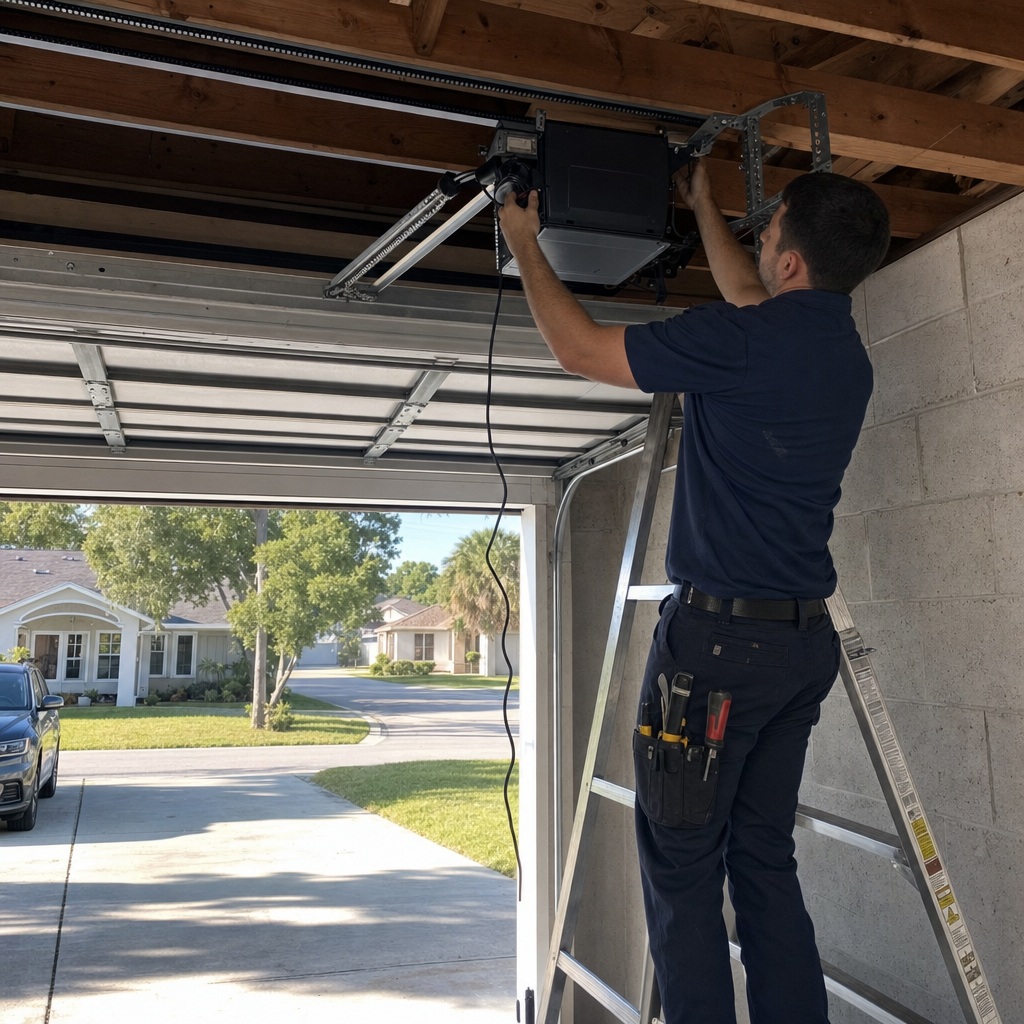
6. Opener
See the next section — openers have their own climate-specific considerations in Jacksonville’s heat and humidity.
For a complete diagnostic on any of these components, our Garage Door Repair in Jacksonville page covers what to expect and how the repair process works.
Garage Door Openers in Jacksonville’s Heat and Humidity
Garage temperatures in Jacksonville regularly hit 105–115°F in summer — high enough to shorten the lifespan of circuit boards, capacitors, and motor windings in garage door openers that aren’t designed for the environment. Humidity compounds the problem by promoting corrosion on logic board contacts and switch terminals inside the unit.
The brands we install and service most frequently in Jacksonville — LiftMaster, Chamberlain, Genie, and Craftsman — all offer models with thermal protection and humidity-resistant logic boards, but there’s a meaningful difference between entry-level and mid-to-upper-tier models in how they handle sustained Florida heat. A belt-drive or direct-drive opener generates less heat during operation than a chain-drive equivalent, which matters when the garage itself is already hot.
Key Opener Considerations for Jacksonville Homeowners
- Battery backup: Jacksonville averages 78 thunderstorm days per year. A battery backup opener (LiftMaster’s 8550W and Chamberlain’s B6765 are common examples) means a power outage during a storm doesn’t strand you inside or outside.
- Wi-Fi connectivity and myQ: LiftMaster and Chamberlain’s myQ platform lets you confirm door status remotely — genuinely useful during evacuation planning before a hurricane.
- Horsepower for door weight: Heavier insulated steel doors, especially at 24-gauge with a polyurethane core, require at least a ¾ HP motor. Undersized motors overheat in sustained summer use.
- Safety sensors: The photoelectric safety sensors at the bottom of the door frame are low to the ground and exposed to lawn irrigation spray. Clean and realign them as part of every seasonal maintenance visit.
For a full breakdown of opener options and what the installation process looks like, see our Garage Door Opener in Jacksonville page.
A Seasonal Maintenance Schedule Built for Jacksonville
National maintenance guides typically say “lubricate once a year.” In Jacksonville, that’s not enough. The humidity, heat cycling, and UV exposure demand a more frequent rhythm.
Before Hurricane Season (May)
- Inspect and lubricate torsion springs with a white lithium or silicone-based spray — never WD-40, which displaces moisture temporarily but leaves no lasting film.
- Inspect cables for fraying, kinking, or loose wrapping at the drum. If you see any separation of individual wire strands, call a technician before the season starts.
- Test manual release function. In a power outage during a storm, you need to know the red cord works and the door moves freely by hand.
- Confirm the door’s wind-load hardware (if present) is intact — horizontal braces and reinforcing struts should be tight and uncracked.
- Inspect bottom weatherseal for cracking or gaps. A compromised seal means significant water intrusion during a tropical rain event.
Midsummer (July–August)
- Wipe down and re-lubricate rollers — summer heat accelerates lubricant breakdown on steel rollers.
- Check track alignment and fastener tightness. Heat expansion loosens bolts that were secure in the spring.
- Clean safety sensor lenses — summer lawn irrigation and dust accumulation cause nuisance reversal events.
After Hurricane Season (November)
- Full visual inspection of panels for impact dents, which can compromise panel integrity and become water-entry points.
- Inspect and clean opener logic board area for evidence of moisture intrusion.
- Lubricate all hinges and check for corrosion, especially on oceanside properties.
- Test opener force limits and auto-reverse to confirm proper settings heading into the drier season.
Common Mistakes to Avoid
- Buying a builder-grade 26-gauge steel door for a coastal property. Thin-gauge steel dents from minor impact and offers minimal structural resistance. In Atlantic Beach or Ponte Vedra, that gauge choice also means faster rust-through — typically within five to seven years without aggressive maintenance.
- Skipping the permit on a door replacement. Jacksonville requires permits for most garage door replacements in load-bearing openings. An unpermitted installation means no inspector confirmed wind-load compliance — and your insurer may use that to deny storm damage claims.
- Using WD-40 as a spring or hinge lubricant. It’s a solvent, not a lubricant, and it washes away the factory coating on springs. White lithium grease or a dedicated garage door spray lubricant is the correct product.
- Ignoring a slow or noisy door. In Jacksonville’s humidity, a door that’s progressively noisier or slower is signaling component wear — usually roller corrosion or spring fatigue. Catching it early is dramatically cheaper than the emergency call after a spring breaks at 7 a.m. on a Monday.
- Installing a wood door without a maintenance commitment. We’ve refinished and repaired dozens of wood doors in Riverside and Avondale that were beautiful at installation and warping within four years. If you want the wood look without the upkeep, composite is the smarter choice in Northeast Florida’s climate.
- Choosing an opener by price alone. An entry-level opener in a 110°F garage running two to four cycles a day will underperform and fail faster than a mid-grade unit with thermal protection. The $80 saved upfront typically costs more within three years.
- Assuming any contractor can handle hurricane-rated work. Florida Product Approval installation requires following the manufacturer’s specific installation instructions exactly — not a general approximation. Verify that your installer is familiar with the FL# documentation for the specific door being installed.
When to Call a Professional
Some garage door maintenance — lubricating hinges, cleaning sensors, replacing a weatherseal — is reasonable DIY work. These scenarios are not:
- Any torsion spring adjustment, replacement, or cable work. The stored energy in a wound spring can cause fractures or worse.
- A door that’s off its tracks. Forcing it back without identifying the root cause typically damages tracks, rollers, and panels simultaneously.
- Any electrical work inside the opener unit itself.
- Post-storm inspection for structural integrity before resuming use — especially after a tropical system passes through Jacksonville.
- Any installation requiring a Florida Building Code permit, which covers most full-door replacements.
Stephanie Cox and the team at Priority Garage Door Solutions Jacksonville home have handled Jacksonville garage doors exclusively for seven years — not as a side service, but as the only thing we do. We offer free estimates and emergency service for situations that can’t wait. Call (386) 463-9742 to schedule.
Frequently Asked Questions
How much does garage door repair cost in Jacksonville, FL?
Most garage door repairs in Jacksonville fall between $120 and $380, depending on the component. Spring replacement typically runs $180–$280 for a standard torsion spring set; cable replacement is usually $120–$200; roller and hinge replacement ranges from $100–$180. Opener repairs vary widely — a logic board replacement on a LiftMaster or Genie unit is typically $150–$250 in parts and labor. Emergency service calls carry a premium over standard scheduled appointments. Call (386) 463-9742 for a free estimate on your specific situation.
Does Jacksonville require a permit to replace a garage door?
Yes — in most cases. Duval County requires a building permit for garage door replacements that involve the structural opening, and the installation must reference the door’s Florida Product Approval (FL#) number to confirm hurricane wind-load compliance. Skipping the permit means skipping the inspection that confirms your door meets code — and that gap can complicate insurance claims after storm damage. When Stephanie’s team installs a new door in Jacksonville, permit handling is part of the process.
How often should I replace my garage door springs in Jacksonville?
In Jacksonville’s humidity, plan on 6–8 years for standard steel torsion springs with regular seasonal lubrication — shorter than the 8–10 year lifespan you’d see in a drier climate. If you’re in Atlantic Beach, Mayport, or Ponte Vedra Beach, salt-air corrosion can reduce that further. Upgrading to galvanized or stainless springs at replacement adds cost upfront but extends service life meaningfully in coastal zones. If your springs are over seven years old and you haven’t had them inspected, before hurricane season is the right time to do it.
What wind-load rating does my Jacksonville garage door need?
For most of Jacksonville (Duval County), the Florida Building Code requires garage doors to be rated for design wind speeds in the 130–140 mph range. The door must carry a Florida Product Approval (FL#) number confirming compliance. Doors without this rating are not code-compliant for new installations in this wind zone, and an existing non-compliant door may affect your homeowner’s insurance coverage if storm damage occurs. If your door was installed before 2002, it almost certainly predates post-Andrew code requirements and is worth evaluating.
Which garage door material is best for Jacksonville’s climate?
For most Jacksonville homeowners, 24-gauge steel with a polyurethane insulated core is the most practical choice — it handles humidity cycling, qualifies for wind-load ratings, and requires far less maintenance than wood in a subtropical environment. For coastal properties in Atlantic Beach or Ponte Vedra, specify stainless or hot-dip galvanized hardware at installation. If the wood aesthetic is important, a steel-core composite door (like Clopay’s Canyon Ridge or Wayne Dalton’s 9700 series) delivers the look without the warping risk that solid wood carries in Northeast Florida’s wet seasons.
Can a garage door be repaired the same day in Jacksonville?
For the most common repairs — broken springs, snapped cables, off-track doors, opener failures — same-day service is realistic when the appointment is booked in the morning and parts are in stock. Stephanie carries the most common spring sizes, cables, and opener components for LiftMaster, Genie, Chamberlain, Craftsman, and other major brands, which means most standard repairs don’t require a return trip. For situations that genuinely can’t wait, emergency service is available — call (386) 463-9742 and describe what’s happening so we can arrive prepared.
The Bottom Line
A garage door in Jacksonville faces a specific set of conditions — high humidity, salt air, hurricane wind loads, and intense UV — that national buying guides and out-of-market contractors routinely underestimate. The right door for this market is wind-load rated, built from 24-gauge steel or marine-grade composite, fitted with corrosion-resistant hardware sized to your distance from the coast, and maintained on a seasonal schedule that accounts for what Northeast Florida weather actually does to mechanical systems. After seven years and 238 jobs across Jacksonville neighborhoods from Atlantic Beach to Mandarin, Stephanie and her team have seen what holds up here — and what doesn’t. If your door is approaching ten years old, showing corrosion, or was installed before Florida’s current hurricane codes, a professional evaluation before storm season is the most cost-effective move you can make.
Ready to talk through your specific door, opener, or repair situation? Call (386) 463-9742 for a free estimate — no obligation, just a straight answer from someone who’s been doing this in Jacksonville for seven years.
Written by Stephanie Cox, Owner & Lead Technician at Priority Garage Door Solutions Jacksonville, serving Jacksonville since 2019.