
Last updated June 24, 2026
Garage Door Repair Maintenance Checklist for Jacksonville Homeowners
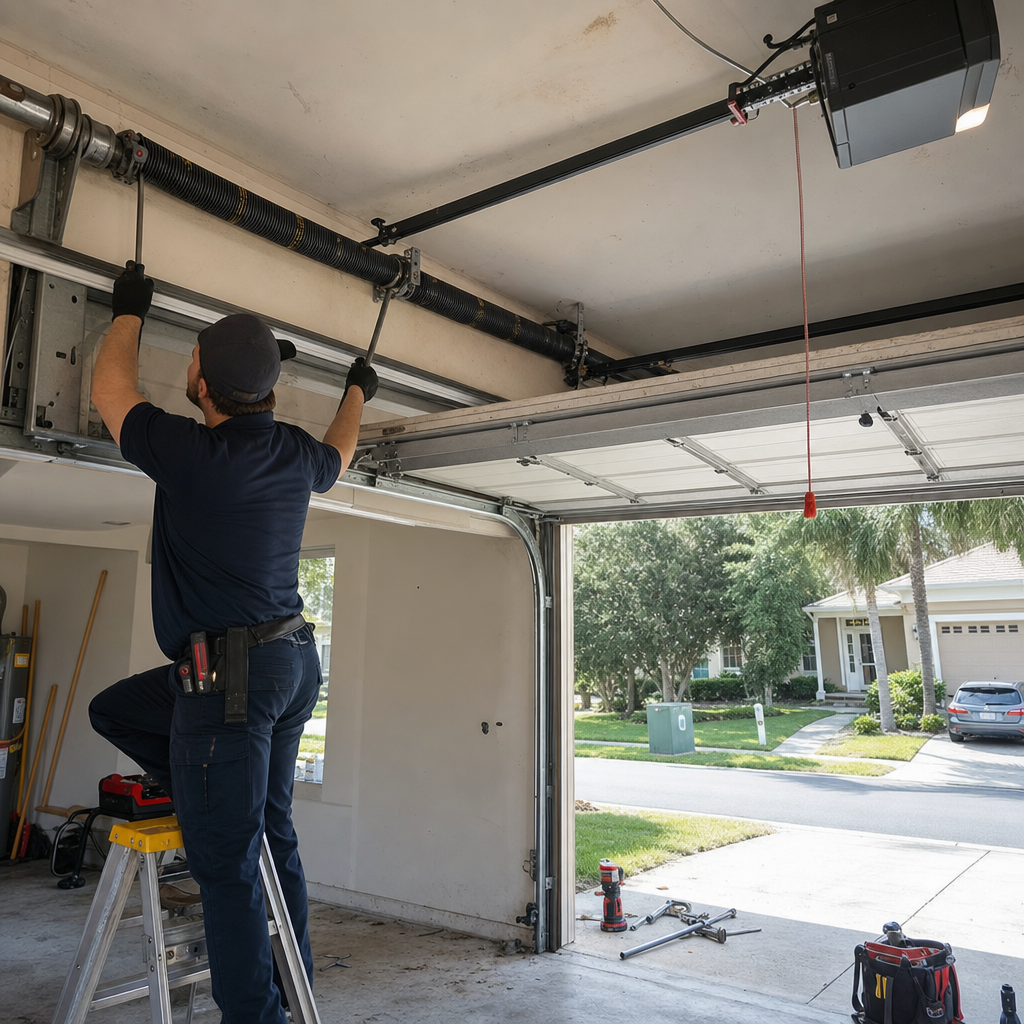
We’ve replaced hundreds of springs in Jacksonville that failed well before their rated cycle count — and in almost every case, the homeowner had no idea that summer humidity was silently corroding the coil from the inside out. Most maintenance guides tell you to lubricate and test your door twice a year. That’s a start, but it’s not nearly enough for a home in Northeast Florida. Jacksonville’s combination of salt air from the St. Johns River corridor, 90°F-plus summers, and a rainy season that dumps over 50 inches of rain annually creates a failure sequence you won’t find described in any manufacturer’s generic manual. This guide gives you the checklist that’s actually calibrated to that environment — task by task, with the reasoning behind every step.
Quick Answer
A garage door maintenance checklist for Jacksonville homeowners should include monthly visual inspections for rust and cable fraying, quarterly lubrication with white lithium grease (not WD-40), a weatherseal check before and after rainy season, and an annual professional inspection of spring tension and cable drums. Jacksonville’s heat and humidity accelerate corrosion and wear faster than the national averages those maintenance intervals are based on — so the standard “twice a year” schedule isn’t enough here.
Table of Contents
- Why Jacksonville’s Climate Changes Everything About Garage Door Maintenance
- Monthly Visual Inspection Checklist (Humidity-Specific)
- The Right Lubricant for Jacksonville Heat
- Weatherseal Inspection Tied to Jacksonville’s Rainy Season
- What You Can Safely Do Yourself vs. What Requires a Pro
- Month-by-Month Maintenance Log for Jacksonville Homeowners
- Common Mistakes to Avoid
- When to Call a Professional
- Frequently Asked Questions
- The Bottom Line
Why Jacksonville’s Climate Changes Everything About Garage Door Maintenance
Generic garage door maintenance advice is written for an average American climate that doesn’t exist in Jacksonville. When spring and cable manufacturers publish cycle-life ratings — typically 10,000 to 15,000 cycles for standard torsion springs — those ratings are tested under controlled indoor conditions, not Northeast Florida’s coastal humidity that routinely sits above 80% from June through September.
What that means practically: the steel coil on your torsion spring absorbs moisture during every humid night and then bakes in direct garage heat during the day. Over months, that cycle creates micro-corrosion inside the coil that’s invisible from the outside until the spring snaps. We see this pattern consistently in neighborhoods like Mandarin, San Marco, and Ponte Vedra Beach, where homes sit close to tidal waterways and salt air compounds the problem further.
The same humidity accelerates rubber degradation in weatherseals and bottom gaskets, causes track paint to bubble and peel (which then traps moisture against bare metal), and shortens the lifespan of the nylon rollers that most modern openers — including LiftMaster and Chamberlain units — rely on for quiet operation. Jacksonville homeowners who follow the manufacturer’s standard biannual maintenance schedule are effectively maintaining a Northern California garage door while living in Florida.
The checklist in this guide is built around that reality. Every interval and every task reflects what we’ve learned over seven years of working on doors across Jacksonville, from Riverside bungalows with original hardware to newer construction in Nocatee.
Monthly Visual Inspection Checklist (Humidity-Specific)
A monthly visual inspection takes under five minutes and catches the problems Jacksonville’s climate creates before they turn into emergency calls. You don’t need any tools — just your eyes and good lighting. Stand inside your garage with the door closed and work through this list top to bottom.
What to Look For Each Month
- Rust bleed on torsion or extension springs. Look for orange-brown streaking on or below the spring coil. Surface rust that wipes away is cosmetic; rust that pits into the coil surface means the metal is compromised. In Jacksonville’s humid months (May–October), check this one first.
- Cable fraying at the drum. The steel cable wraps around a drum at each side of the door. Look for any frayed, kinked, or unraveling strands where the cable meets the drum. Even a single broken strand is a failure in progress — cables carry enormous tension.
- Track paint bubbling or peeling. Bubbled paint on the vertical or horizontal tracks isn’t just cosmetic — it means moisture is sitting between the paint and the metal. Left alone, it becomes rust that roughens the track surface and damages rollers.
- Roller condition. Spin each roller by hand if you can reach it safely. They should spin freely and quietly. Cracked or flat-spotted nylon rollers (common on Genie and Craftsman systems after several humid seasons) create that grinding noise people mistake for a track problem.
- Bottom seal contact with the floor. With the door closed, look for daylight gaps along the bottom edge. Any gap wide enough to slide a finger under is wide enough for rainwater, pests, and conditioned air to move through — a real concern in Jacksonville from June through September.
- Hinge and bracket hardware. Look for bolts that have vibrated loose or hinges showing rust. A loose bottom bracket is one of the more dangerous conditions on a residential door because it’s under cable tension.
The Right Lubricant for Jacksonville Heat
This is the question we get more often than almost any other, and the answer matters more in Jacksonville than in most cities: use white lithium grease, not WD-40.
WD-40 is a water-displacement solvent, not a lubricant. It’s excellent at breaking loose a stuck bolt, but it evaporates quickly, leaves little lasting film, and in Jacksonville’s heat it can actually attract dust and debris that grind against the very surfaces you were trying to protect. On a spring coil or roller track in a garage that reaches 100°F-plus in July, WD-40’s lubricating benefit is essentially gone within a few days.
White lithium grease stays put in high-temperature environments. It forms a protective film on metal surfaces that resists both moisture intrusion and heat evaporation. For Jacksonville homeowners specifically, it’s the right choice for springs, hinges, and roller stems.
What to Lubricate and How Often in Jacksonville
- Torsion springs: Spray white lithium grease along the full length of the coil every three months — not twice a year. Jacksonville’s humidity cycle means a biannual schedule leaves springs unprotected through most of the rainy season.
- Hinges: Apply a small amount to the pivot point of each hinge. Don’t over-apply; excess grease collects dirt.
- Roller stems (not the nylon wheel): Apply grease to the metal stem only. Never grease the nylon wheel itself — it doesn’t need it and excess grease can attract debris that accelerates wear.
- Top of the tracks (not the inside): A light film along the top horizontal track helps the rollers transition smoothly. Do not lubricate the inside vertical track faces — this reduces the friction the door needs for controlled movement.
- Lock mechanism: A small amount of white lithium or powdered graphite keeps the lock cylinder turning through Jacksonville’s hot summers.
Do not lubricate: the chain or belt on your opener (consult the manufacturer — many modern LiftMaster and Chamberlain drives are factory-lubricated and don’t need it), the bottom weatherseal, or the track inside faces.
Weatherseal Inspection Tied to Jacksonville’s Rainy Season
Jacksonville averages more than 50 inches of rainfall per year, with the bulk of it concentrated between June and September. A garage door with a compromised weatherseal during that period isn’t just a nuisance — it’s a pathway for standing water, palmetto bugs, and moisture that warps drywall, encourages mold, and damages anything stored on the garage floor.
The best time to inspect your weatherseal is in late April or early May, before the heavy rain season starts, and again in October after it ends. Here’s what to check:
Bottom Seal (Most Critical)
Close the door completely and examine the bottom rubber gasket from inside. It should make full contact with the floor with no visible gaps. Signs it needs replacement: cracks running perpendicular to the length of the seal, sections that have pulled away from the door panel, portions that are brittle and no longer flex when pressed. If you’ve seen water track marks on your garage floor after heavy rain, the bottom seal is the first place to look. In Jacksonville’s older neighborhoods like Avondale and Murray Hill, we often find original seals on 15-year-old doors that have simply hardened beyond any functional use.
Side and Top Weatherstrip
Run your hand along the side stops and top header seal with the door closed. You should feel consistent contact pressure. Any section that has pulled loose from the door frame or gone rigid is letting conditioned air out and humid Jacksonville air in — and during a storm with any wind, it’s letting water in as well.
Threshold Seal (If Installed)
Some Jacksonville homes have a rubber threshold seal adhered to the garage floor that the door closes against. Check the bond along the full length — if it has lifted in sections, the door is essentially not sealed even if the bottom gasket looks intact.
What You Can Safely Do Yourself vs. What Requires a Pro
We’re a garage door company, so we’ll be straight with you: most of the maintenance on this list is genuinely safe for a homeowner to handle. But two tasks are not, and we want to be clear about exactly why.
Safe for Most Homeowners
- Visual inspection (monthly)
- Lubrication of springs, hinges, and roller stems
- Weatherseal and bottom gasket replacement (standard push-in or screw-on types)
- Tightening loose hinge and bracket bolts (but stop if any are under obvious tension)
- Cleaning tracks with a damp cloth
- Testing the auto-reverse safety function on your opener
- Replacing opener batteries and reprogramming remotes
Two Tasks That Always Require a Licensed Technician
1. Spring tension adjustment or replacement. Torsion springs on a residential garage door are under hundreds of pounds of torque. Adjusting or replacing them without the correct winding bars and training has caused serious injuries and fatalities — this isn’t cautionary language, it’s a documented safety record. If your spring breaks or you notice uneven tension (one side of the door lifts higher than the other), stop using the door and call a professional. This is true regardless of your DIY skill level.
2. Cable drum adjustment or cable replacement. The cables run from the bottom bracket — which is under spring tension — up to the drums. Working on either end of that cable without releasing spring tension first puts you in direct contact with stored mechanical energy you can’t see or predict. We’ve been called out for emergency service throughout Jacksonville to address exactly this kind of situation.
If you’re ever unsure whether something you’re looking at falls into the DIY or pro category, the safest default is to stop and call. A free inspection costs nothing. An emergency room visit costs considerably more.
Month-by-Month Maintenance Log for Jacksonville Homeowners
This schedule is built around Jacksonville’s actual seasonal weather patterns, not a generic national template. Print it out and keep it on the wall of your garage — the best maintenance log is the one you’ll actually use.
January–February (Cool, Dry Season)
- Visual inspection (springs, cables, rollers, tracks)
- Lubricate springs, hinges, and roller stems with white lithium grease
- Test auto-reverse: place a 2×4 flat on the floor under the door and activate the close cycle; the door must reverse on contact
- Test the wall button, all remotes, and keypad
March–April (Transitional — Humidity Rising)
- Visual inspection
- Inspect bottom seal, side weatherstrip, and top header for pre-rainy-season condition
- Replace any weatherseal showing cracks or rigidity before June
- Check all hardware bolts for looseness after winter temperature cycles
May–June (Rainy Season Begins)
- Visual inspection — pay particular attention to rust bleed on springs
- Lubricate springs again — this is the critical application before peak humidity
- Verify threshold seal bond if installed
- Check opener photo-eye sensors: wipe lenses clean (storm debris is common)
July–August (Peak Heat and Humidity)
- Visual inspection
- Check opener motor housing for heat-related issues: LiftMaster and Chamberlain units have thermal cutouts that can trip repeatedly if the garage isn’t ventilated
- Listen for new noises during operation — heat expansion can reveal loose hardware that was quiet in cooler months
September–October (Post-Hurricane Season Wind-Down)
- Full visual inspection post-storm season
- Lubricate springs, hinges, roller stems
- Inspect tracks for any dents or misalignment from storm debris
- Second weatherseal inspection — replace anything that didn’t survive rainy season
November–December (Cooler, Drier)
- Visual inspection
- Annual balance test: disconnect the opener (pull the red cord), manually lift the door to waist height, and release it. A properly balanced door stays in place; a door that falls or rises sharply has a spring tension issue that needs professional attention
- Check and tighten all roller brackets and hinge hardware
- Schedule professional inspection if any issues were flagged during the year
Common Mistakes to Avoid
- Using WD-40 as a long-term lubricant on springs. WD-40 evaporates in Jacksonville’s heat within days and leaves the spring surface unprotected. It also temporarily masks the squeak that was telling you something needed attention — so the problem continues undetected.
- Ignoring rust bleed because the door still operates. A spring showing surface rust corrosion in the coil gaps is on its way to failure — it’s not a question of if, only when. In Jacksonville’s humidity, a spring showing early rust can fail within a single season. Don’t wait for the snap to take it seriously.
- Lubricating the inside face of the tracks. We see this regularly on doors that suddenly won’t stay closed or make loud banging sounds at the top of travel. The inside track face needs friction to guide the rollers, not grease. Lubricate only the top horizontal section.
- Skipping weatherseal replacement because the door looks fine from outside. By the time water damage is visible inside your garage — staining, warped drywall, rust on stored tools — the seal has been failing for at least one full rainy season. The inspection is what prevents the visible damage, not the response to it.
- Attempting to adjust spring tension to fix an uneven door. An uneven door is a symptom, not the problem. The cause could be a tension imbalance, a broken cable, a bent track, or a worn roller — and diagnosing it correctly before touching the spring is critical to both safety and not making the situation worse.
- Assuming a Clopay, Amarr, or Wayne Dalton door has the same hardware specs as the previous door it replaced. Brand and model differences matter for spring sizing, cable length, and drum diameter. Parts that look interchangeable sometimes aren’t. Using the wrong spring weight on a heavy wood-look Clopay door, for example, puts immediate stress on the opener motor and accelerates cable wear.
- Waiting until the door fails to schedule service. The most expensive garage door repairs we do in Jacksonville are the ones that started as a noise or a slight resistance in operation three months before the homeowner called. A $40 roller replacement that gets ignored becomes a $300 track repair when the worn roller damages the track surface.
When to Call a Professional
Call a professional technician — not a general handyman — when you observe any of the following:
- A broken or visibly cracked torsion spring (the coil will show a clear gap)
- A cable that has come off the drum, is visibly frayed, or is hanging loose
- A door that falls quickly when manually released at waist height during the balance test
- Any bottom bracket that appears bent, cracked, or pulled away from the door panel
- An opener that runs but the door doesn’t move — this often means a stripped drive gear, which worsens with every cycle
- A door that has been struck by a vehicle, even lightly — impact forces distribute through the panel and track system in ways that aren’t always visible
- Loud grinding, banging at the top of travel, or a door that stops mid-cycle without an obstruction present
Priority Garage Door Solutions Jacksonville offers free estimates — Stephanie Cox will assess the situation, tell you exactly what needs to be done and why, and give you a straight answer on cost before any work begins. Call (386) 463-9742 to schedule. For urgent situations — a door stuck open overnight, a broken spring that’s left your car inside — emergency service is available when it can’t wait.
Frequently Asked Questions
How often should I lubricate my garage door in Jacksonville?
Every three months — not twice a year. Jacksonville’s humidity and heat cycle break down lubricant film faster than the national standard maintenance interval assumes. The most important applications are in late spring (just before rainy season begins in June) and again in early fall after the heaviest humidity has passed. Use white lithium grease on springs, hinges, and roller stems — not WD-40, which evaporates too quickly in Florida heat to provide lasting protection.
What’s the most common garage door repair in Jacksonville?
Broken torsion springs are the most common repair we handle across Jacksonville, from Riverside to the Beaches. Humidity-driven corrosion is the leading cause — it shortens spring life well below the manufacturer’s rated cycle count. The second most common repair is weatherseal replacement, particularly after hurricane season, when bottom gaskets and side seals take a beating from wind and standing water. Regular lubrication and pre-season weatherseal inspections catch both problems before they become emergency calls. Call (386) 463-9742 if you’re seeing rust on your springs or daylight gaps under your door — estimates are free.
Can I replace a garage door bottom seal myself?
Yes — on most residential doors, the bottom seal attaches via a T-slot channel or is screwed directly to the bottom panel, and replacing it is a straightforward DIY task. Measure the door width before purchasing a replacement, and choose a seal rated for UV and heat exposure, since Jacksonville’s sun degrades standard rubber seals faster than in cooler climates. The one exception: if the bottom bracket on either corner is bent or pulled away, stop and call a professional before touching anything nearby — that bracket is under cable tension.
How do I know if my garage door springs need replacing?
The clearest sign is a visible gap in the torsion spring coil — that means it has snapped and the door should not be operated until the spring is replaced. Before it breaks, warning signs include rust visible in the coil gaps, a door that feels heavier than usual when lifted manually, uneven lifting (one side rises before the other), or a loud bang from the garage that sometimes wakes the household. If you’re in Jacksonville and seeing any of these signs, call for an inspection rather than waiting for a failure — a broken spring during a busy morning costs more in time and emergency fees than a proactive replacement.
Is it safe to use my garage door if I hear grinding or squeaking?
A squeak that goes away after lubricating the hinges and roller stems is normal wear — lubricate and monitor. A grinding noise that persists after lubrication usually means a roller is worn flat, a hinge is cracking, or a track has a rough spot from rust or impact. Continuing to operate the door accelerates the damage: a worn roller grinds against the track surface and eventually causes a track repair that costs several times more than a roller replacement. If the grinding is loud, intermittent, or accompanied by the door moving unevenly, stop using the door and have it looked at. Call (386) 463-9742 — we can often diagnose over a call before scheduling a visit.
How long do garage doors last in Jacksonville’s climate?
A steel or fiberglass door from brands like Clopay, Amarr, or Wayne Dalton typically lasts 20–30 years in Jacksonville with consistent maintenance — but the hardware (springs, cables, rollers) has a much shorter service life. Torsion springs in Jacksonville’s humidity often last 7–12 years rather than the 10–15-year range manufacturers rate them for in controlled conditions. Openers from LiftMaster, Chamberlain, and Genie generally last 10–15 years, with the drive mechanism (chain, belt, or screw) being the first component to show significant wear. The door panel itself outlasts almost everything else — which is why maintenance that extends hardware life protects what is often a $1,500–$4,000 investment in the door itself.
The Bottom Line
A garage door in Jacksonville doesn’t fail on a national average schedule — it fails on a Florida schedule shaped by heat, humidity, salt air, and a rainy season that tests every seal, spring, and roller the door has. The checklist in this guide isn’t designed to sell unnecessary service visits. It’s designed to help you catch the specific failure sequence Jacksonville’s climate creates before it catches you. Monthly visual inspections, quarterly lubrication with the right product, pre-season weatherseal checks, and knowing exactly which two tasks require a professional — those habits are what separate a door that works reliably for 20 years from one that generates emergency calls every few summers. Consistent, specific maintenance is always cheaper than the repairs it prevents.
If you’re ready to have a professional set of eyes on your door — or if something in this guide flagged an issue you want assessed — Stephanie and her team at Garage Door Repair in Jacksonville are available for free estimates across Jacksonville. For new door questions, visit our Garage Door Installation in Jacksonville page. If your opener is the concern, the Garage Door Opener in Jacksonville page covers every major brand we service. Or start at the Priority Garage Door Solutions Jacksonville home to see the full scope of what we do. Call (386) 463-9742 to schedule — estimates are free, and there’s no pressure to commit on the spot.
Written by Stephanie Cox, Owner & Lead Technician at Priority Garage Door Solutions Jacksonville, serving Jacksonville since 2019.